Guest Checkout
Increasing first-time conversion by letting shoppers check delivery before they register.

+3.64%
conversion
+507
orders/day
~£7.4M
more annual revenue
+3.64%
conversion
+507
orders/day
~£7.4M
more annual revenue
COMPANY
ROLE
PLATFORM
Ocado Technology
Product Designer
Web
Context
Ocado Technology builds a B2B2C grocery e-commerce platform used by retailers worldwide under their own brand.
Features have to scale across partners while meeting the needs of their shoppers on web, iOS and Android.
First-time shoppers represent a significant share of growth, but conversion was heavily constrained by early funnel friction. Users were required to register before validating delivery availability, creating uncertainty at a critical decision point.
Problem
Registration came before users could answer one key question: "Can I get my groceries delivered when I need them?"
Registration was the largest drop-off point in the funnel
20% of users saw unavailable products after choosing a delivery slot
Finding problems late reduced trust and intent to buy

My role
Led discovery and user research across 3 markets
Defined hypotheses, success metrics and the experiment roadmap
Designed end-to-end flows, from slot booking to guest checkout, and high-fidelity prototypes
Facilitated stakeholder alignment across Product, Engineering and Data
Led the A/B testing strategy and the final rollout recommendation
Discovery
Research
24 moderated user interviews across the UK, Canada and Spain (8 per market)
300 survey responses across 3 different markets
Funnel analysis of registration drop-off and unavailable products
What we learned
1. Forced registration blocks intent
Users hesitate to commit before understanding value
2. Availability visibility is critical
Delivery slots and fees are key decision drivers
3. Late failures break trust
Unavailable products at checkout create frustration
Key insight
Users need to validate service viability before committing personal details
Key insight
Users need to validate service viability before committing personal details
Data
Registration is the largest drop-off point in the funnel

% of first time shoppers per day seeing unavailable products

First time shoppers conversion from booking a slot

Data
Registration is the largest drop-off point in the funnel
% of first time shoppers per day seeing unavailable products
First time shoppers conversion from booking a slot
Approach
Approach
Platform constraint
Product availability depends on the delivery slot
The delivery slot requires registration
Core challenge: Break this dependency without major platform rework
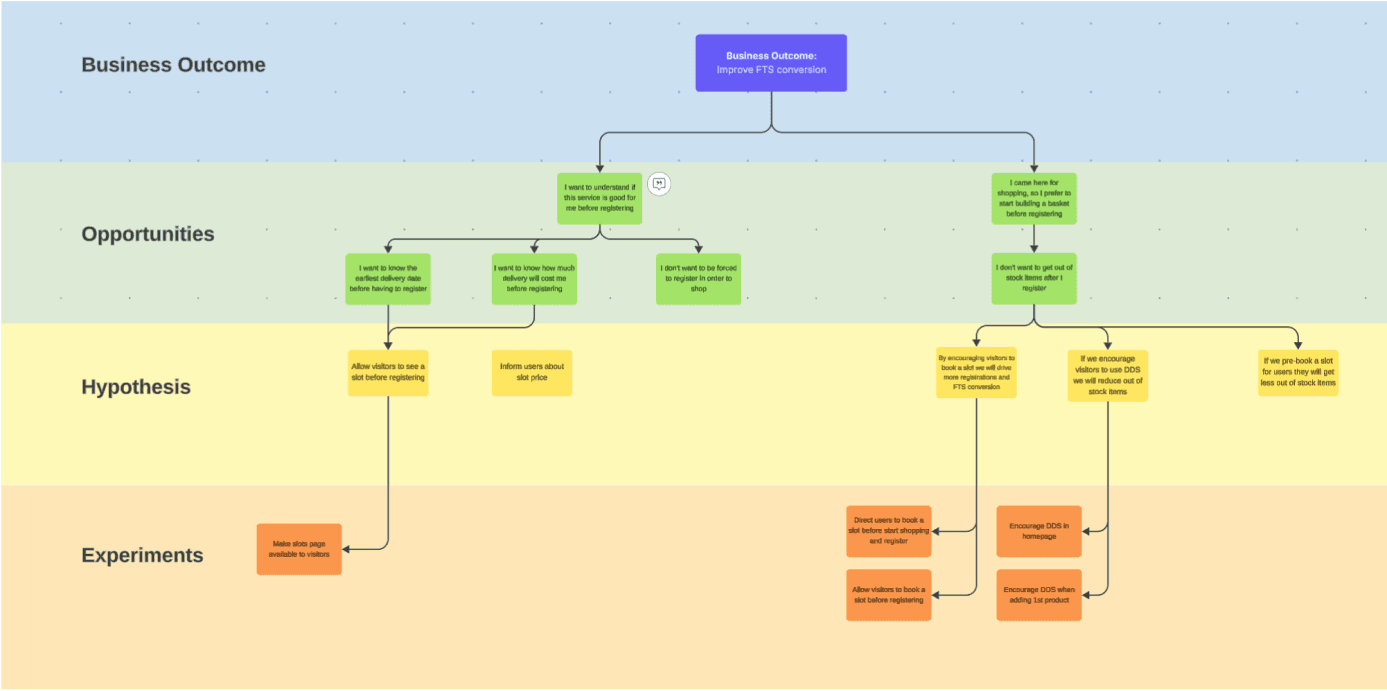
Two hypotheses
1
We believe if users can check delivery availability before registering, first-time conversion will rise, uncertainty will drop and trust will grow.
2
We believe if users can complete first shop before registering, first-time conversion will rise, uncertainty will drop and trust will grow.
Cross-functional Workshop
I facilitated a workshop with Product, Engineering and Data to align on the problem and the experiment approach.
Output:
Reframed issue from registration to timing of registration
Surfaced different views on how to test guest checkout
Identified key technical constraints early
Impact:
Accelerated alignment and enabled faster, lower-risk experimentation


Vision prototype
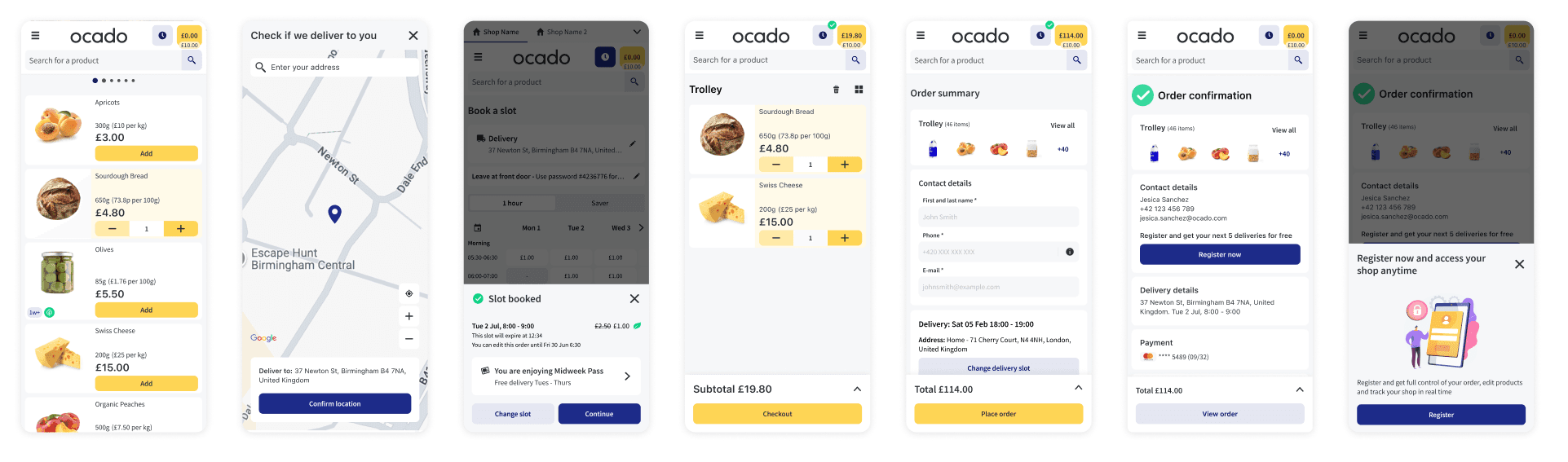
I designed a north star prototype where users could check availability and complete a purchase before registering.
Purpose:
Align stakeholders on a shared vision
De-risk decision-making before building
Guide sequencing of experiments
Goals:
Check delivery availability before registration
Book slot early
Checkout without registration
Impact:
Provided a clear direction, ensuring each experiment moved towards a consistent end-state
Validating the vision
Tested the north star prototype with users to validate whether the proposed flow reduced uncertainty and improved confidence.
What we learned:
1
Users strongly preferred checking availability before registering
2
Early slot visibility increased confidence to proceed
3
Removing forced registration reduced hesitation
Vision prototype
I designed a north star prototype where users could check availability and complete a purchase before registering.
Purpose:
Align stakeholders on a shared vision
De-risk decision-making before building
Guide sequencing of experiments
Goals:
Check delivery availability before registration
Book slot early
Checkout without registration
Impact:
Provided a clear direction, ensuring each experiment moved towards a consistent end-state
Validating the vision
Tested the north star prototype with users to validate whether the proposed flow reduced uncertainty and improved confidence.
What we learned:
1
Users strongly preferred checking availability before registering
2
Early slot visibility increased confidence to proceed
3
Removing forced registration reduced hesitation
Aligning on the approach
Engineering proposed a fast, low cost guest checkout. It was quick to build, but risky for users:
Guests who chose to register lost their basket and booked slot
Guests couldn't edit or cancel orders without calling support
We were concerned it could lose users instead of converting them. The PM and I also believed the value wasn't only in guest checkout, but in letting users see and book delivery slots early.
Testing both options
Instead of debating, we tested both. I designed two prototypes, the fast build and the ideal guest checkout, and ran 8 moderated usability sessions.
What we learned from the fast build:
Losing progress breaks trust. All 8 participants reacted negatively when asked to register halfway and lost their basket and slot. Most said this would make them abandon and not come back.
Calling to cancel feels frustrating. Participants described it as not transparent. Several said they wouldn't return after this experience.
Minimum expectations were clear. If they had to call, they expected a fast response and an email explaining the next steps.
What users said
"If I lose everything I added, I'm not starting again. I'll just go somewhere else."
Outcome
I shared the results with engineering and proposed a progressive approach: build in small steps, learn from each one, and only invest in full guest checkout once the value was proven. Engineering agreed. Evidence replaced opinion, and the team aligned on the experiment roadmap below.
Experimentation
We ran a series of progressive experiments, each building on the last. We balanced:
Learning speed
Engineering effort
Business impact
Results are measured against the original baseline.
EXPERIMENT 1:
Show delivery slots to visitors
Change: Expose delivery slots before registration


+0.29%
conversion
+40
orders/day
What we learned:
Visibility alone reduces uncertainty, but users still hesitate to commit.
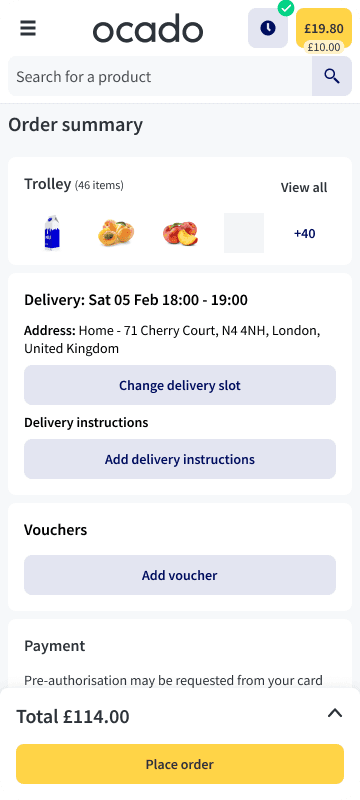
EXPERIMENT 2:
Allow visitors to book a slot
Change: Users can reserve a delivery slot before registering



+1.21%
conversion
+169
orders/day
What we learned:
Commitment increases intent, but friction still exists at checkout.
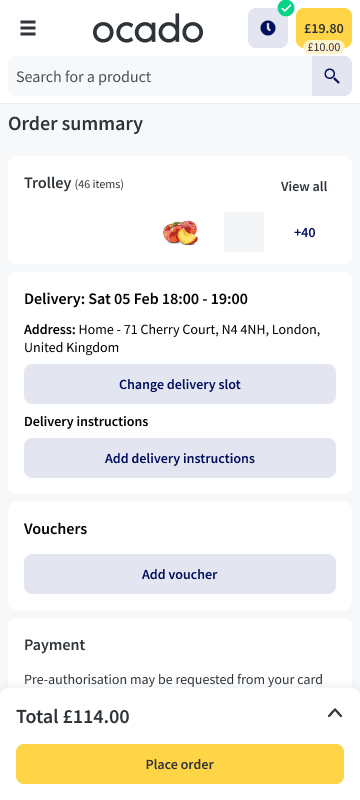
EXPERIMENT 3:
Trigger early slot selection for visitors
Change: Prompt users to book a slot earlier in the journey



+2.11%
conversion
+294
orders/day
What we learned:
Early validation reduces late-stage frustration and builds confidence.
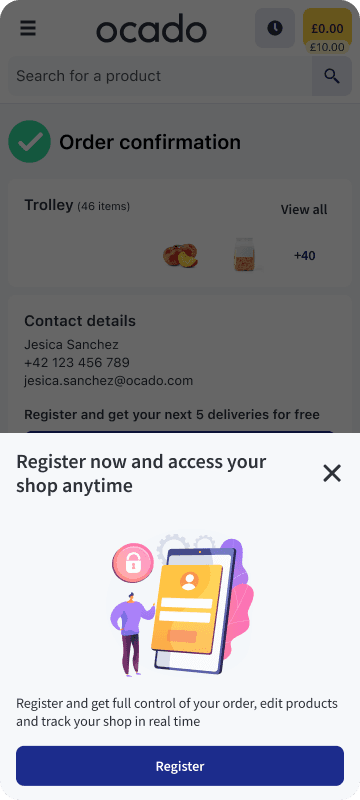
EXPERIMENT 4:
Guest checkout
Change: Allow users to complete checkout before registering


+3.64%
conversion
+507
orders/day
What we learned:
Removing mandatory registration at the point of highest intent has the largest impact.
Key trade-offs
User experience vs data capture.
Guest checkout reduces upfront data collection
Speed vs engineering complexity.
Later experiments required deeper platform changes
Operational constraints vs flexibility. Slot handling needed careful orchestration
Final solution, rolled out on web
Early delivery slot validation
Clear product availability
Guest checkout
Registration moved to after purchase
Impact
+3.64% first-time conversion
+507 orders a day
~£7.4M additional annual revenue, based on 507 extra orders a day and a £40 average order value
Registration changed from a barrier to a step in context
Set up a repeatable experimentation approach for the team
Learnings
Timing matters more than removing steps. Registration wasn't the problem. Asking for it too early was.
Progressive tests reduce risk. Small steps let us prove value before making deeper platform changes.
A north star keeps experiments focused. Every test moved toward the same end goal.
Test disagreements, don't debate them. Putting both options in front of users aligned the team faster than any discussion.
Next steps
Optimise post-purchase registration
Explore pre-booking a delivery slot for visitors
Continue experimentation on onboarding
Expansion to additional markets
Optimise post-purchase registration
Explore pre-booking a delivery slot for visitors
Continue experimentation on onboarding
Expansion to additional markets
Guest Checkout
Increasing first-time conversion by letting shoppers check delivery before they register.
+3.64%
conversion
+507
orders/day
~£7.4M
more annual revenue
COMPANY
ROLE
PLATFORM
Ocado Technology
Product Designer
Web
Context
Ocado Technology builds a B2B2C grocery e-commerce platform used by retailers worldwide under their own brand.
Features have to scale across partners while meeting the needs of their shoppers on web, iOS and Android.
First-time shoppers represent a significant share of growth, but conversion was heavily constrained by early funnel friction. Users were required to register before validating delivery availability, creating uncertainty at a critical decision point.
Problem
Registration came before users could answer one key question: "Can I get my groceries delivered when I need them?"
Registration was the largest drop-off point
20% of users saw unavailable products after slot selection
Late discovery of issues reduced trust and intent
My role
Led discovery and user research across 3 markets
Defined hypotheses, success metrics and the experiment roadmap
Designed end-to-end flows, from slot booking to guest checkout, and high-fidelity prototypes
Facilitated stakeholder alignment across Product, Engineering and Data
Led the A/B testing strategy and the final rollout recommendation
Discovery
Research
24 moderated user interviews across the UK, Canada and Spain (8 per market)
300 survey responses across 3 different markets
Funnel analysis of registration drop-off and unavailable products
What we learned
1. Forced registration blocks intent
Users hesitate to commit before understanding value
2. Availability visibility is critical
Delivery slots and fees are key decision drivers
3. Late failures break trust
Unavailable products at checkout create frustration
Key insight
Users need to validate service viability before committing personal details
Data
Registration is the largest drop-off point in the funnel
% of first time shoppers per day seeing unavailable products
First time shoppers conversion from booking a slot
Approach
Platform constraint
Product availability depends on the delivery slot
The delivery slot requires registration
Core challenge: Break this dependency without major platform rework
Two hypotheses
1
We believe if users can check delivery availability before registering, first-time conversion will rise, uncertainty will drop and trust will grow.
2
We believe if users can complete first shop before registering, first-time conversion will rise, uncertainty will drop and trust will grow.
Cross-functional Workshop
I facilitated a workshop with Product, Engineering and Data to align on the problem and the experiment approach.
Output:
Reframed issue from registration to timing of registration
Surfaced different views on how to test guest checkout
Identified key technical constraints early
Impact:
Accelerated alignment and enabled faster, lower-risk experimentation
Vision prototype
I designed a north star prototype where users could check availability and complete a purchase before registering.
Purpose:
Align stakeholders on a shared vision
De-risk decision-making before building
Guide sequencing of experiments
Goals:
Check delivery availability before registration
Book slot early
Checkout without registration
Impact:
Provided a clear direction, ensuring each experiment moved towards a consistent end-state
Validating the vision
Tested the north star prototype with users to validate whether the proposed flow reduced uncertainty and improved confidence.
What we learned:
1
Users strongly preferred checking availability before registering
2
Early slot visibility increased confidence to proceed
3
Removing forced registration reduced hesitation
Aligning on the approach
Engineering proposed a fast, low cost guest checkout. It was quick to build, but risky for users:
Guests who chose to register lost their basket and booked slot
Guests couldn't edit or cancel orders without calling support
We were concerned it could lose users instead of converting them. The PM and I also believed the value wasn't only in guest checkout, but in letting users see and book delivery slots early.
Testing both options
Instead of debating, we tested both. I designed two prototypes, the fast build and the ideal guest checkout, and ran 8 moderated usability sessions.
What we learned from the fast build:
Losing progress breaks trust. All 8 participants reacted negatively when asked to register halfway and lost their basket and slot. Most said this would make them abandon and not come back.
Calling to cancel feels frustrating. Participants described it as not transparent. Several said they wouldn't return after this experience.
Minimum expectations were clear. If they had to call, they expected a fast response and an email explaining the next steps.
What users said
"If I lose everything I added, I'm not starting again. I'll just go somewhere else."
Outcome
I shared the results with engineering and proposed a progressive approach: build in small steps, learn from each one, and only invest in full guest checkout once the value was proven. Engineering agreed. Evidence replaced opinion, and the team aligned on the experiment roadmap below.
Experimentation
We ran a series of progressive experiments, each building on the last. We balanced:
Learning speed
Engineering effort
Business impact
Results are measured against the original baseline.
EXPERIMENT 1:
Show delivery slots to visitors
Change: Expose delivery slots before registration
+0.29%
conversion
+40
orders/day
What we learned:
Visibility alone reduces uncertainty, but users still hesitate to commit.
EXPERIMENT 2:
Allow visitors to book a slot
Change: Users can reserve a delivery slot before registering
+1.21%
conversion
+169
orders/day
What we learned:
Commitment increases intent, but friction still exists at checkout.
EXPERIMENT 3:
Trigger early slot selection for visitors
Change: Prompt users to book a slot earlier in the journey
+2.11%
conversion
+294
orders/day
What we learned:
Early validation reduces late-stage frustration and builds confidence.
EXPERIMENT 4:
Guest checkout
Change: Allow users to complete checkout before registering
+3.64%
conversion
+507
orders/day
What we learned:
Removing mandatory registration at the point of highest intent has the largest impact.
Key trade-offs
User experience vs data capture.
Guest checkout reduces upfront data collection
Speed vs engineering complexity.
Later experiments required deeper platform changes
Operational constraints vs flexibility. Slot handling needed careful orchestration
Final solution, rolled out on web
Early delivery slot validation
Clear product availability
Guest checkout
Registration moved to after purchase
Impact
+3.64% first-time conversion
+507 orders a day
~£7.4M additional annual revenue, based on 507 extra orders a day and a £40 average order value
Registration changed from a barrier to a step in context
Set up a repeatable experimentation approach for the team
Learnings
Timing matters more than removing steps. Registration wasn't the problem. Asking for it too early was.
Progressive tests reduce risk. Small steps let us prove value before making deeper platform changes.
A north star keeps experiments focused. Every test moved toward the same end goal.
Test disagreements, don't debate them. Putting both options in front of users aligned the team faster than any discussion.
Next steps
Optimise post-purchase registration
Explore pre-booking a delivery slot for visitors
Continue experimentation on onboarding
Expansion to additional markets